|

Understanding through Discussion |
|
|
Register | Sign In |
|
QuickSearch
| EvC Forum active members: 65 (9164 total) |
|
| |
| ChatGPT | |
| Total: 916,914 Year: 4,171/9,624 Month: 1,042/974 Week: 1/368 Day: 1/11 Hour: 1/0 |
| Thread ▼ Details |
|
|
| Author | Topic: "Best" evidence for evolution. | ||||||||||||||||||||||||
|
Taq Member  Posts: 10085 Joined: Member Rating: 5.6 |
To add one more log on the fire, I would add conservation of exons and divergence of introns to the list. Francis Collins (the guy who headed the NIH Human Genome Project) wrote and excellent essay called "Faith and the Human Genome" (found here). In it (pg 148) he talks about a gene that is conserved across quite a few vertebrates, from puffer fish to humans. He shows how areas of the exons are conserved while meaningless introns become much different through the accumulation of neutral mutations. To me, this is very compelling, especially in the Evolution v. Creationism forums. Why? Well, why would a creator change introns so that they exactly match evolutionary predictions? Why not just copy the introns exactly from one species to the next?
|
||||||||||||||||||||||||
|
Simonster Junior Member (Idle past 5376 days) Posts: 3 Joined: |
The best evidence for the theory of evolution for me personally is irreducible complexity.
IC is scientific and it is very clever in my opinion and it had the potential to break the ToE's neck. Unfortunately it not only failed to falsify the ToE, but the fact that scientists were able to explain how IC parts of creatures were formed actually reinforced my confidence in the ToE. But I still admire Behe for it, since it was plausible and I learned how "IC" parts actually evolve thanks to Millers explanation during the Dover trial in response to Behe's hypothesis. Edited by Simonster, : Put the third IC in quotes, since it became clear that there is no such thing as a IC part that couldn't have evolved as far as we know. Edited by Simonster, : D'oh! It's called DoveR not Dove...
|
||||||||||||||||||||||||
|
olivortex Member (Idle past 4808 days)  Posts: 70 From: versailles, france Joined: |
I agree on this. here is a page with the details from ken Miller, though you may have seen it before:
The "flagellum unspun".http://www.millerandlevine.com/km/evol/design2/article.html It is indeed an "important" point in the battle between ID an ET people, once more, the argument didn't stand long.
|
||||||||||||||||||||||||
|
Taq Member Posts: 10085 Joined: Member Rating: 5.6 |
It is indeed an "important" point in the battle between ID an ET people, once more, the argument didn't stand long.
The IC argument was dealt the death blow before Behe was even born. This is a quote from 1918: "Most present day animals are the result of a long process of evolution, in which at least thousands of mutations must have taken place. Each new mutant in turn must have derived its survival value from the effect which it produced upon the "reaction system" that had been brought into being by the many previously formed factors in cooperation; thus a complicated machine was gradually built up whose effective working was dependent upon the interlocking action of very numerous elementary parts or factors, and many of the characters are factors which, when new, where originally merely an asset finally become necessary because other necessary characters and factors had subsequently become changed so as to be dependent on the former. It must result, in consequence, that a dropping out of, or even a slight change in any one of these parts is very likely to disturb fatally the whole machinery; ..."--"Genetic Variablity, Twin Hybrids and Constant Hybrids, in a Case of Balanced Lethal Factors", by Hermann J Muller, in Genetics, Vol 3, No 5, Sept 1918, pp 422-499. The ironic twist is that we should actually expect to see IC systems if evolution is true.
|
||||||||||||||||||||||||
|
olivortex Member (Idle past 4808 days) Posts: 70 From: versailles, france Joined: |
Sure, it brings us way back, but i actually think many people got it all wrong because of this:
"To suppose that the eye, with all its inimitable contrivances for adjusting the focus to different distances, for admitting different amounts of light, and for the correction of spherical and chromatic aberration, could have been formed by natural selection, seems, I freely confess, absurd in the highest possible degree. Yet reason tells me, that if numerous gradations from a perfect and complex eye to one very imperfect and simple, each grade being useful to its possessor, can be shown to exist; if further, the eye does vary ever so slightly, and the variations be inherited, which is certainly the case; and if variation or modification in the organ be ever useful to an animal under changing conditions of life, then the difficulty of believing that a perfect and complex eye could be formed by natural selection, though insuperable by our imagination, can hardly be considered real." [p. 217, Charles Darwin, 1859. The Origin of Species by Means of Natural Selection or the Preservation of Favoured Races in the Struggle for Life. John Murray, London, 1859 (published by Penguin Books, London, England, 1968, reprinted 1986 with an introduction and bibliography by J.W. Burrow] That brings us even earlier, to the starting point of the battle, in fact 
|
||||||||||||||||||||||||
|
Sarawak Member (Idle past 5508 days)  Posts: 47 Joined: |
I think plants offer some of the easiest to understand and experimentally reproducible evolution work. A good book to start with is Karl Niklas' The Evolutionary Biology of Plants. Botanists estimate that 20-40% of existing plant species have arisen through a process of hybridization, a process not normally available to animals (but who knows?). That is an astounding number and several plant species have been experimentally derived from known wild plants through a plant hybridization process and the produced species are identical to known wild species. The rapid life cycles of plants compared to animals is a big advantage.
Our green friends often get ignored.
|
||||||||||||||||||||||||
|
Taq Member Posts: 10085 Joined: Member Rating: 5.6 |
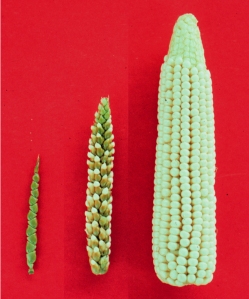
Our green friends often get ignored. I avoided them in college, too. I went for a degree in zoology so I wouldn't have to take a botany class. With that said . . . We often focus on mammalian examples of human breeding programs, such as dogs. However, our cultivars are pretty impressive examples of evolution as well. One of the most impressive is teosinte, the wild version of corn. If you were to run across it in the wild you might mistake it for a wierd looking grass with a wheat-like head. Not so. The evolutio of teosinte into modern corn varieties is a very good story.
|
||||||||||||||||||||||||
|
Sarawak Member (Idle past 5508 days) Posts: 47 Joined: |
Taq:
Ah, yes corn. I spent hours discussing corn with George Beadle. Late in life he hit the lecture circuit with something like "The Mystery of Maize". It was pretty good. Did you have an opportunity to hear that? I was thinking sunflowers. It's in Niklas' book. Edited by Sarawak, : an oops!
|
||||||||||||||||||||||||
|
Lithodid-Man Member (Idle past 2961 days)  Posts: 504 From: Juneau, Alaska, USA Joined: |
I reallly like the example of corn because it contains all of the critical elements with a result that most anyone can understand. iirc the natural part of corn evolution was polyploidy followed by mutations in several of the duplicated genes. Then hoo-mons came along and further selected those genes further. I may have some elements wrong, as it has been many years since my evolutionary genetics class.
This is a great counter to the 'no new information' (or similar) argument. You have duplication of existing genes, then those genes mutate and the result is something brand new, an ear, a tassle, a soft seedcoat, etc that did not exist in the wild form. Doctor Bashir: "Of all the stories you told me, which were true and which weren't?" Elim Garak: "My dear Doctor, they're all true" Doctor Bashir: "Even the lies?" Elim Garak: "Especially the lies"
|
||||||||||||||||||||||||
|
RAZD Member (Idle past 1435 days)  Posts: 20714 From: the other end of the sidewalk Joined: |
My dad talks about when sweet corn first appeared on the market - the ear was about 8" long and the kernals were in paired rows with gaps between them, 16 rows in 8 groups around the cob.
Sweet corn - Wikipedia
quote: Probably one of those supersweets. Enjoy. Edited by RAZD, : wiki by our ability to understand Rebel American Zen Deist ... to learn ... to think ... to live ... to laugh ... to share. • • • Join the effort to solve medical problems, AIDS/HIV, Cancer and more with Team EvC! (click) • • •
|
||||||||||||||||||||||||
|
shalamabobbi Member (Idle past 2879 days)  Posts: 397 Joined: |
These count for evidence IMO.
At the very least, they promise greater variety at KFC..
|
||||||||||||||||||||||||
|
Sarawak Member (Idle past 5508 days) Posts: 47 Joined: |
Here's a shortened paragraph (p64, Niklas' Evolutionary Biology of Plants)
"One of the most stunning "laboratory" investigations of speciation is that of Loren Rieseberg and his coworkers, who reproduced the genetic changes leading to the formation of a naturally occurring species of sunflower (Helianthus anomalus)......Under laboratory conditions these changes are repeatable across independent experiments....The two putative ancestral species of H. anomalus are H. annuus and H. petiolaris. All three species are self incompatible annuals....hybridized H. annuus and H. pertiolaris to produce three independent hybrid lines that were subjected to different sib mating and back crossing regimes......lines converged to nearly identical gene combinations including parallel changes in the nonrearranged portions of chromosomes.....the path of evolutionary change was repeatable in ways suggesting that selection rather than chance governs the genetic composition..." Sorry about hacking the paragraph so much, but there are copyright concerns. If you have access to Science, here's a reference: Science 28 November 2003:Vol. 302. no. 5650, p. 1499 DOI: 10.1126/science.302.5650.1499 Edited by Sarawak, : No reason given.
|
||||||||||||||||||||||||
|
WarriorArchangel Member (Idle past 4034 days) Posts: 14 From: Lynn MA US Joined: |
Our species is 99.8% Neanderthal genome. How did that happen?
They eneded up in the Northern Israeli wilderness, circa 700,000 years ago. The people in the wilderness that Cain thought, would kill him. He interbred with them, and borne the first modern humans....
|
||||||||||||||||||||||||
|
Adminnemooseus Administrator  Posts: 3976 Joined: |
I'll track down a good Neanderthal topic for you, so you don't plaster things Neanderthal in bad places.
But I have some downloads happening right now, and my internet connection is really bogging down - So it may take a while. Adminnemooseus Added by edit: I bumped a topic. It can also be found via this link. Edited by Adminnemooseus, : ABE.Or something like that.
|
||||||||||||||||||||||||
|
WarriorArchangel Member (Idle past 4034 days) Posts: 14 From: Lynn MA US Joined: |
Don't do me ay favors. They ended up in Northern Israel circa 700,000 years ago. They were made by Lucifer to be sexually compatible with the modern humans HaShem would make. The
"Adam" means 'a new species'. He wanted to have His son borne by the virgin He made. It didn't turn out that way, because of Lucifer. In the guise of a serpent..... Made the "New Species" experience auto-erotic orgasm by bitingin to the "forbidden fruit"..... HaShemRules his legions....OrgasmRules mankind..... Can't have immortality and have a kid every nine months..... "Strange race these dumbed down humans." All of that entails the Almighty God. (I am the Almighty God, and there is none else.)
|
||||||||||||||||||||||||
|
|
Do Nothing Button
Copyright 2001-2023 by EvC Forum, All Rights Reserved
 ™ Version 4.2
Innovative software from Qwixotic © 2024